
95% are stuck
Most leaders have piloted AI and watched almost none of it reach the bottom line. Tools got adopted; the operating model never changed.
Adopting AI is table stakes. Becoming AI-native — rewiring how you think, decide, and lead — is what separates the executives who define this decade from the ones who spend it catching up. AI Native Workforce University is where you make that shift, and earn the credential that proves it.

“If you are a CEO and you are not already well into AI execution — not exploration — you have a problem. The middle is no longer a safe place to be.”
 John Chambers
Former Chairman & CEO, Cisco
John Chambers
Former Chairman & CEO, Cisco
UnifyApps co-founder and Enterprise Brain author Ragy Thomas on what's actually changing — and why becoming AI-native is the defining move of this generation of leaders.
 Film coming soon
Ragy Thomas — Co-Founder & Co-CEO, UnifyApps · Founder & Chairman, Sprinklr · Author of The Enterprise Brain
Most leaders have piloted AI and watched almost none of it reach the bottom line. Tools got adopted; the operating model never changed.

As John Chambers warns, the middle is no longer a safe place to be. Waiting has quietly become the riskiest move an executive can make.

A small group rewired how work actually gets done — decoupling growth from headcount and compounding the advantage every quarter.
This program moves you into the 5% — the AI-native leaders with the architecture, the operating model, and the judgment to lead the shift.
Built on the #1 bestseller by Ragy Thomas, Sravan Vadigepalli, and Chandhu Nair, this is the program's flagship. You'll move from why most AI initiatives stall to a working blueprint for the cognitive enterprise — the Context Graph, the CCRAG architecture, and the assembly-first operating model.
Where every AI-native leader starts — domain-specific programs to follow.
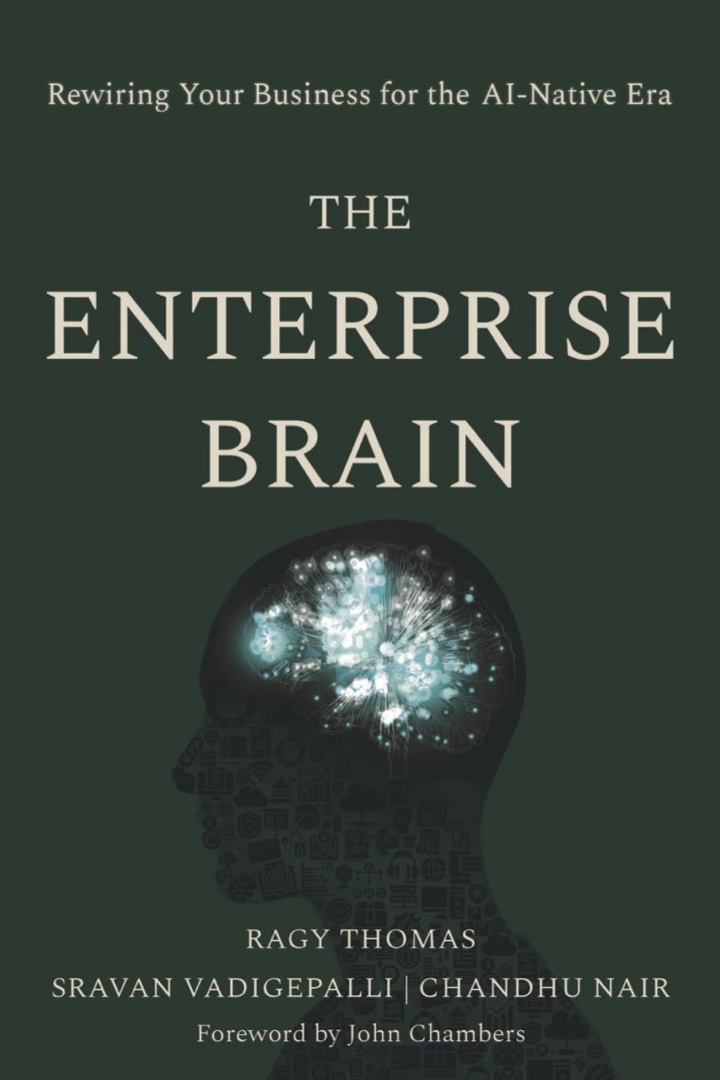
The program takes you inside this architecture — five systems, modeled on the human mind, operating as one on a single unified knowledge layer.
The Three Decouplings and the GenAI Divide — why 5% of enterprises are pulling decisively ahead, and what the leaders driving them see that the other 95% miss. Reading the Sputnik moment for what it is.
The Cognitive Shift, the three stages of AI maturity, and the decoupling economics that let revenue grow while headcount holds flat.
The adoption crisis up close — the Administrator Trap that stalls transformation and the Governor Shift that redefines what leaders actually do.
Escaping the App Trap. The Enterprise OS, the CCRAG framework, and the Context Graph that gives agents a real model of your business.
Running it for real: AgentOps, a governance control tower, and the economic engine that turns the architecture into compounding results.
The self-scaling enterprise and the renaissance of work — designing the organization, and the leadership, the next decade rewards.
A private, async Slack workspace for leaders applying the framework — peer-led, no cohorts, no schedule.
The Enterprise Brain is a masterclass in enterprise design, proving that in an age of commoditized reasoning, our only lasting edge is our architectural courage and the depth of our organizational context. It asks leaders to build from how the enterprise actually thinks, decides, and acts.


AI is not a software upgrade, but a redesign of how a business thinks, decides, and acts. The book gives leaders a structural view of the human, operational, and governance changes this era demands.


For leaders defining what AI transformation means for their organizations, this book offers both near-term clarity and long-term frameworks to act with confidence. It gives the work a structure, not just a vocabulary, and makes the path forward feel governable.


A large-enterprise lens on the shift from AI adoption to organizational redesign. Less about tools, more about the work a company must become capable of doing if it wants to expand through the AI era.

Names what many transformations miss: people do not only resist technology. They resist what a new way of working reveals. This is not a skills gap alone. It is a safety, identity, and leadership gap.


A concrete argument for the knowledge layer most enterprise AI systems are missing: context that lets agents understand the business, not just the prompt in front of them. The point is not better prompting. It is a unified operating memory.


A board-level view of AI transformation: strategy, architecture, and execution connected in one operating conversation for leaders trying to build durable advantage. The book makes AI-native transformation feel less abstract, and more like a company leaders can actually build.


Not another AI playbook. A sharper question for leaders: how must the company actually run when intelligence becomes operational, and execution has to move beyond legacy rails?

Frames the next decade of work as an architectural evolution: from managing tasks to governing systems. The shift is not simply faster work. It is a different operating model.


Cuts through the obvious layer of AI hype to ask where durable enterprise value will actually accrue, and why so much apparent value disappears before it becomes advantage. It is a rare argument about the bottlenecks, not the spectacle.


Individuals get certified. Teams get aligned. When a leadership group shares one model of the AI-native enterprise, the whole organization starts to think and move as one system.
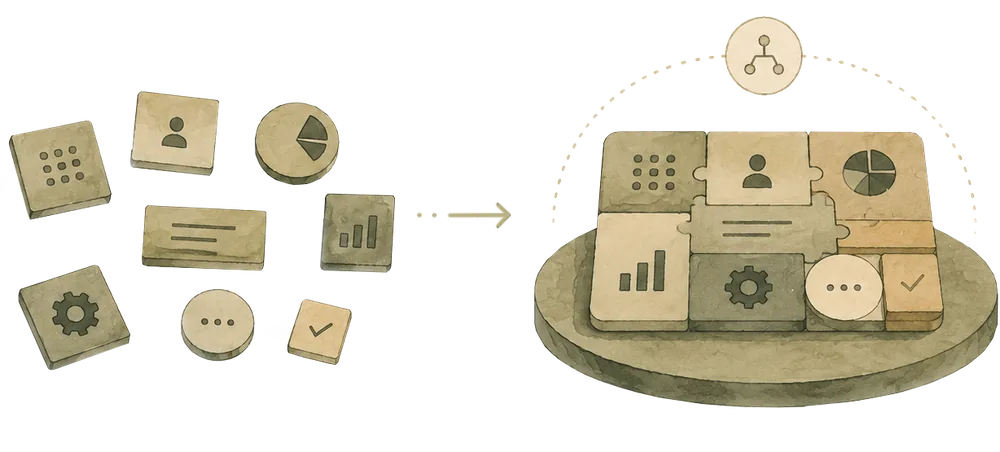
From the CIO to the line leader, everyone works from the same frameworks, vocabulary, and governance model.
A shared architecture removes the translation tax between strategy and execution — the place transformation usually stalls.
Certified leaders demonstrate they can govern the systems doing the work, not just talk about AI.
AINW University's program runs on Lyearn, our learning platform. Here's what that means for your information.
AINW University's courses and certification run on Lyearn, our learning platform. When you enrol, you create a Lyearn account to work through the modules, track your progress, and complete the AI assessment. ainw.university is the public site; Lyearn is where the program itself lives.
Only what's needed to run the program — module progress, lesson completion, assessment submissions and results, and time spent on materials — so your place is saved and your certification can be issued and verified. Your name and email are used to award the credential.
Your progress and assessment work are private to you and the AINW University team that administers the program. If your organization enrolls you as part of a team, designated administrators can see completion status — not your individual assessment content. We never sell your data.
Your information is stored and processed by Lyearn — encrypted in transit (TLS 1.2+) and at rest (AES-256), with role-based access, alignment to ISO/IEC 27001 principles, and annual third-party security assessments. More on our privacy page.
Email compliance@lyearn.com any time to request access to or deletion of your learning data or account, and Lyearn will action it in line with its policy. More on our privacy page.
No. A single Lyearn account gives you the full program and your certificate — there's no separate AINW University login to manage.
Tell us about your team and we'll be in touch about enterprise certification.